
Why Is My Snow Plow Blade Broken? Causes and How to Prevent It
A broken cutting edge never picks a good time. It takes a truck off the road mid-storm and puts a crew to work changing heavy steel in the cold. The impact can damage the moldboard behind it, too.
The good news is that most breaks are preventable. They usually come from hitting obstructions too fast, loose or wrong hardware, running a blade until it wears into the moldboard, or a blade that isn’t built for the job. This guide explains how to read a break, what causes each kind and how to prevent the next one.
Read the break first
Where and how a blade broke usually points to the cause. Start here, then go to the section that matches.
- A blade cracked or snapped at one spotA hard hit on an obstruction, such as a manhole cover, bridge joint or drain, often at speed.Go to Cause 1
- Sheared, bent or missing boltsThe blade worked loose. Bolts that weren’t torqued to spec, or aren’t Grade 8, let the blade shift until they snap.Go to Cause 2
- Damage to the moldboard behind the bladeA blade run past its limit, so the wear moved into the moldboard’s angle iron.Go to Cause 3
- Cracked or missing carbide insertsRepeated impact on brittle tungsten carbide inserts, which crack and fall out.Go to Cause 4
- Broken or chewed blade endsCurb strikes at the ends of the blade, where nothing protects it.Go to Cause 4
Cause 1: Hitting obstructions too fast
Most breaks start with an impact. Manhole covers, bridge joints, drains, potholes and curbs all catch a cutting edge. One hit at low speed may do no harm, but repeated hits at speed crack blades and damage the moldboard.
Speed is the part you control. It depends on the route: up to 45 mph on highways and slower on city streets. Slower speeds generally mean less damage to the road and to the plow. See 3 Avoidable Things That Cause Low-Bid Blades to Severely Damage Roads and 6 Unbreakable Rules for Snow Plow Driver Safety.
How a trip edge protects the plow
A trip edge lets the cutting edge tip back when it hits an obstruction, so it can pass over without taking the full blow. It’s protection, not permission. Driving too fast over obstructions still breaks blades, damages the moldboard and slams the front of the plow.
Plows trip in different ways. On a sectional plow, the moldboard trips in separate sections, so only the part that hits the obstruction moves. A full-trip plow trips all at once. That spreads the pressure across the whole moldboard, which extends wear life.
Train drivers to see what’s coming
Drivers who know their routes know where the obstructions are. Teach crews how each one affects the plow, and make slowing down for them a habit. Before the season, mark hidden obstructions so they’re easy to see. See 5 Best Practices for Dealing With Road Obstacles.
Cause 2: Loose or wrong hardware
If a blade broke without a big impact, look at the hardware. A loose blade shifts and flexes with every bump, and that strain breaks bolts and cracks blades.
Loose blades usually come down to two mistakes: the wrong nut or bolt, or a bolt that was never torqued to spec. Use Grade 8 plow bolts with hardened lock nuts, which resist mushrooming. Tighten every bolt to the manufacturer’s torque spec, then re-check it after the first 10 hours of use. It’s All About Torque explains how, and It’s Risky Business to Use the Wrong Plow Bolt covers which bolts to use.
Hardware mistakes that break blades
- Welding nuts to bolts. The heat weakens both.
- Using lock washers. They can gouge the moldboard where the blade bolts on.
- Installing over dirt, rust or sand. Debris in the threads lets bolts work loose.
- Stacking blades to stretch their life. Doubled blades need longer bolts, and longer bolts are more likely to shear. See Doubling Up on Blades to Extend Their Life? Yikes!
- Trusting the torque wrench all winter. Cold weather affects it, so recalibrate it several times during the season.
Cause 3: Running a blade too long
The moldboard is the curved face of the plow. Along its bottom runs a steel angle iron, and that’s what the cutting edge bolts to. The cutting edge is the part that’s meant to wear, but run a blade past its limit and the wear moves into the angle iron. Then there’s less surface for the blade to rest against, so more of the load lands on the bolts. That extra backward torque on the blade breaks bolts and blades. Worn far enough, the angle iron can wear right through the bolt holes.
The fix is to never let it get that far: drivers should check cutting edge wear every shift and replace each blade before it reaches the angle iron. Blades don’t always wear evenly, so check the ends as well as the middle. How Do I Save My Cutting Edge From Uneven Blade Wear? explains how to spot uneven wear early.
Cause 4: The wrong blade or set-up for the job
Some breaks come from the blade itself. Standard tungsten carbide inserts are brittle, so repeated impact makes them crack and fall out, taking the blade’s wear life with them.
Winter Carbide™ is built to take that impact. It’s more ductile than traditional tungsten carbide, so it absorbs impact instead of shattering and stays in the blade for its full life. Three cutting edge systems carry it, each rated against a standard tungsten carbide insert cutting edge:
- Razor® with Winter Carbide™A 2x WearFactor, or twice the wear life.View the system
- Razor® XL with Winter Carbide™A 3x WearFactor.View the system
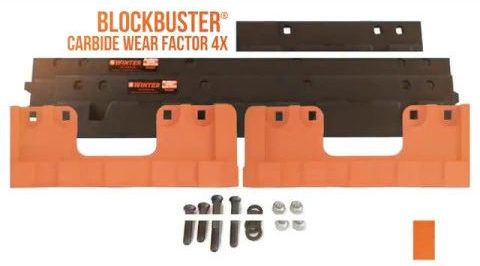
- BlockBuster® with Winter Carbide™A 4x WearFactor, built for heavy-duty routes.View the system
Each one is a complete system, with blades, guards and hardware made to work together. Its guards protect the blade ends, where curb strikes do the most damage.
Set-up matters too. Parts that weren’t made to work together create weak points, and Why Carbide and Cover Set-ups Don’t Work explains why. Not sure what fits your routes? A free consultation matches the blade to how you plow.
Prevention checklist
Most of these take minutes. Doing them on a schedule is what stops the next break.
Before the season
- Replace any cutting edge that’s close to its wear limit.
- Install blades on clean surfaces with Grade 8 bolts and hardened lock nuts.
- Torque every bolt to spec, then re-check it after the first 10 hours of use.
- Calibrate your torque wrench.
- Mark hidden obstructions on each route.
Every shift
- Check cutting edge wear, at the ends as well as the middle, and replace any blade before it reaches the angle iron.
- Remind drivers of the safe speed for their route and where its obstructions are.
After every storm
- Inspect blades for cracks, chips and missing carbide.
- Look for loose, bent or missing bolts.
- Recalibrate your torque wrench a few times during the season.
Frequently asked questions
Why do snow plow bolts shear?
Usually because the blade worked loose. Bolts that weren’t torqued to spec, or aren’t Grade 8, let the blade shift until they snap. Longer bolts from stacked blades are also more likely to shear.
Can I weld the nut to the bolt to keep it tight?
No. Welding heats the nut and bolt, and heat weakens them. Use a hardened lock nut and torque it to spec instead.
What’s the difference between a trip edge and a full-trip plow?
A trip edge lets the cutting edge tip back when it hits something. On a full-trip plow, the whole moldboard trips at once. Either way, slowing down for obstructions still matters.
Related Videos

Subscribe to our blog
"*" indicates required fields